
 |
|
|
|
|
|
|
|
|
|
|
|
|
|
 |
|
||||||||||||
 |
 |
 |
 |
 |
 |
 |
 |
 |
 |
 |
 |
 |
|

|
How the Smart-Link Radio network works.
Smart-Link Radio is a rugged, affordable radio network for central alarm reporting. It replaces telephone lines as a primary reporting means. The patented technology is a more resilient means of traditional wireless systems that rely on a single path linked by costly repeaters to further communications. How it Works: Smart-Link Radio system is a network, made up of 2-way communicators. Each alarm site is linked to the network by a "smart" subscriber unit which is an intelligent device that is both a transceiver and a repeater. Alarm signals are sent through the network to a central location and then sent to your central station or Fire Alarm Dispatch. The signal is transmitted directly to the central receiver if the subscriber is within radio range, relayed through one or more smart transceivers or through one of our many "IP" links. These IP links collect data from far away radios and instantly send it through the internet to our servers. IP links not only speed up the network but also reduce traffic going through the network. Redundant routes enhance reliability reducing the need for costly repeaters. Redundancy is a key feature of the network. From any given transceiver, there are many different routes the alarm message can take. If a message cannot be sent by one route, the intelligent transceiver automatically selects the next best route. This dynamic process is ongoing at every site. Network intelligence is distributed. Smart-Link transceivers dynamically adapt themselves to changes in the network to optimize system operation. Supervised, 2-way transceivers check in constantly. If a unit fails to check in, the central station is alerted and the operator can assess problems from their console. Confirming messages reply to every transmission. Compatibility: Smart-Link Radio transceivers connect to virtually all alarm panels accepting both 4/2 and contact ID formats. |
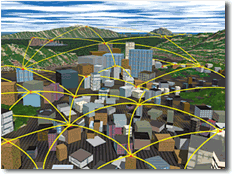 Illustration
of the multiple / redundant routing of the Smart-Link
Radio
/AES-IntelliNet system. Distant subscribers use other units to relay their
messages to the central station. Message routing is optimized dynamically,
adapting automatically to system changes.
Illustration
of the multiple / redundant routing of the Smart-Link
Radio
/AES-IntelliNet system. Distant subscribers use other units to relay their
messages to the central station. Message routing is optimized dynamically,
adapting automatically to system changes.(617) 837 - 9582 or 866 RADIO 11 (866-723-4611)
(c) Copyright 2006 Corporate Development & Management